When discussions arise about the 8th Central Pay Commission (CPC), the term “fitment factor” frequently takes centre stage. It’s a technical term but one with very real consequences—especially for government employees hoping for a salary revision in 2026. So, what exactly is the fitment factor, and how does it influence your salary under the 8th CPC? In this article, we break it down in a simple, user-friendly manner and explore why it matters more than you might think.
What is the Fitment Factor?
The fitment factor is a numerical multiplier used by Pay Commissions to revise and adjust existing salaries of government employees. It bridges the gap between old pay scales and the new ones introduced under a Pay Commission.
In simple terms, it determines how much your basic pay will increase in the next pay commission cycle. A higher fitment factor means a higher jump in basic salary.
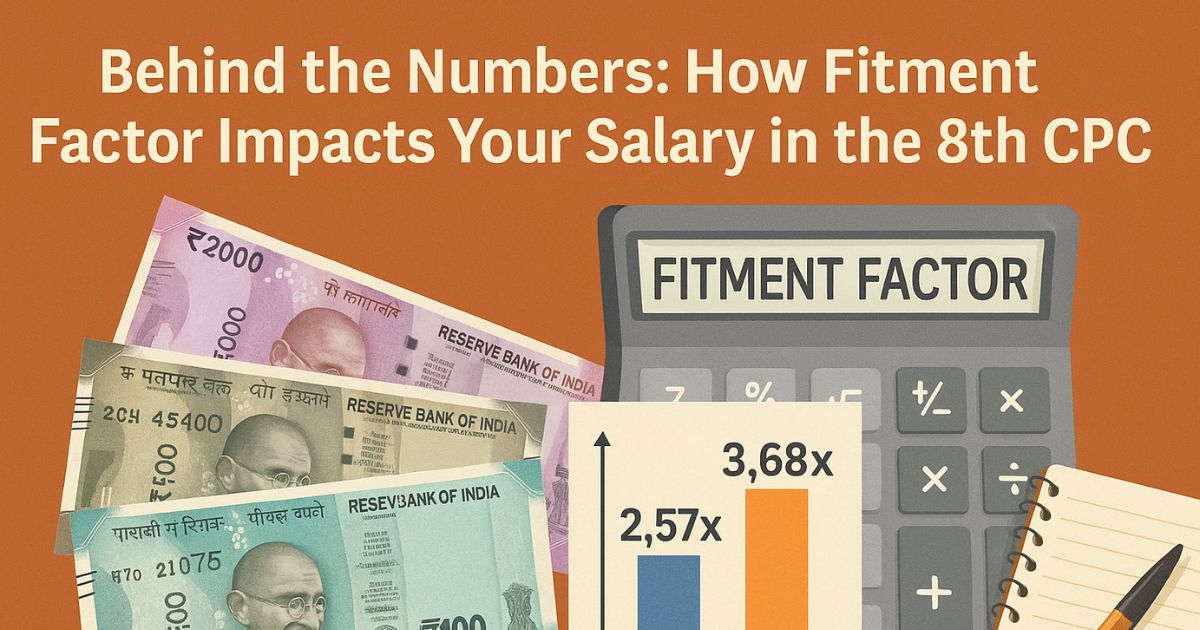
For example, during the 7th CPC, the fitment factor was fixed at 2.57x, meaning the basic pay was increased by 2.57 times the 6th CPC pay.
Why Does the Fitment Factor Matter?
While allowances like DA (Dearness Allowance), HRA (House Rent Allowance), and TA (Transport Allowance) also play a role in total salary, the fitment factor directly impacts the core structure of your salary. That’s because most allowances are calculated as a percentage of your basic pay.
So, if the fitment factor is higher, everything else goes up with it.
Fitment Factor in the 8th Pay Commission: What’s Expected?
As we inch closer to the implementation of the 8th Pay Commission in 2026, speculation is rife about the expected fitment factor. Several unions have demanded a fitment factor of 3.68x, which would significantly increase salaries across the board.
Let’s understand this with an example:
🔹 Comparison Table:
| Basic Pay (7th CPC) | Proposed Fitment Factor | Revised Basic Pay (8th CPC) |
|---|---|---|
| ₹25,500 | 3.0 | ₹76,500 |
| ₹35,400 | 3.0 | ₹1,06,200 |
| ₹44,900 | 3.0 | ₹1,34,700 |
| ₹56,100 | 3.0 | ₹1,68,300 |
This shows that even a small change in fitment factor can have a big impact on your monthly salary.
The Role of the 8th Pay Salary Calculator
The 8th Pay Salary Calculator is a useful tool for central government employees and pensioners to:
-
Estimate expected salary based on different fitment factors
-
Include allowances like DA, HRA, and TA
-
Plan financially for upcoming pay structure changes
These calculators are updated regularly based on DA changes and projected CPC recommendations. They simplify what would otherwise require complex manual calculations.
How is the Fitment Factor Decided?
The Central Pay Commission decides the fitment factor based on:
-
Inflation Trends: Cost of living changes measured via CPI (Consumer Price Index).
-
Economic Conditions: Government’s fiscal capability and budgetary constraints.
-
Employee Demands: Input from employee unions and federations.
-
Pay Parity: Maintaining parity between various posts and pay levels across departments.
-
Comparative Pay Structures: Often compared with state government or private sector salaries.
The decision is made after detailed study, expert recommendations, and multiple rounds of stakeholder consultation.
Challenges and Concerns
While employees push for a higher fitment factor, the government must balance expectations with economic feasibility. A steep hike could:
-
Increase fiscal burden on the exchequer
-
Lead to inflationary pressure
-
Trigger pay revision demands from state governments
That said, government employees argue that a higher fitment factor is justified given rising living costs, stagnant salaries, and growing responsibilities.
Looking Ahead: What Should Employees Do?
As the 8th Pay Commission process unfolds:
✅ Stay Updated with official announcements and union negotiations
✅ Use the 8th Pay Salary Calculator to understand your potential salary scenario✅ Plan Finances Ahead—a higher salary may also impact tax liability
While the final fitment factor will be announced officially, preparing in advance helps avoid surprises.
Final Thoughts
Understanding the fitment factor is crucial if you want clarity on how much your salary could change under the 8th Pay Commission. It’s more than just a number—it’s the foundation of your future salary structure. Whether you’re a newly appointed employee or nearing retirement, knowing how the fitment factor works can help you plan better.
For real-time updates and personalised salary estimates, don’t forget to use the 8th Pay Salary Calculator—your reliable partner for staying ahead of policy changes.
Image generated using AI
Image generated using AI